
Do You Really Need a Knee Replacement? 26 Questions About Knee Arthritis, Answered
Most patients reach an orthopaedic clinic at Grade 3. Dr. Joel Prasad explains what can be done at every stage — and when a replacement is genuinely necessary.
Medical disclaimer: This article is general health education, not a diagnosis or a treatment plan. Every knee is different. Please discuss anything you read here with your own orthopaedic surgeon or physiotherapist before acting on it.
Disclosure: Avana Surgical Systems distributes Breg and Aspen Medical Products braces in India, including the offloader braces mentioned in this article. Dr. Joel Prasad was not paid to endorse any product, and no product recommendation here should be taken as a substitute for your own doctor's assessment.
Most people who come to an orthopaedic clinic with knee pain arrive at the last stage of arthritis, looking for a quick fix. By then, the options have narrowed. Caught earlier, the same knee often responds to treatment that involves no surgery at all.
This article is drawn from a live patient webinar hosted by Avana Surgical Systems with Dr. Joel Prasad, Consultant Orthopaedic, Sports Medicine and Robotic Joint Replacement Surgeon, Bangalore. Over the session he explained how knee arthritis develops, how it is graded, what can be done at each stage, and — the question almost everyone came with — when a knee replacement is genuinely necessary.
We have kept it in question-and-answer form, in the order patients actually asked. The full webinar recording is at the end.
Part 1 — Understanding knee arthritis
1. What exactly is knee arthritis?
Arthritis means degeneration inside the knee joint, usually from wear and tear. Inside the joint, the ends of the thigh bone and leg bone are lined with a smooth layer called articular cartilage. This lining lets the two bones glide against each other without friction. In arthritis, that cartilage gradually erodes, and the smooth glide is lost.
2. What is the difference between primary and secondary arthritis?
Primary arthritis has no identifiable cause. It is age-related degeneration that appears without any injury behind it. If you have had no accident, no infection, no swelling — and then the knee simply starts hurting or swelling — that points to primary arthritis.
Secondary arthritis happens because of a reason: an old injury, an infection, a previous fracture, rheumatoid arthritis, or another inflammatory condition. If you had a knee problem earlier and the pain has now increased, you are most likely dealing with secondary arthritis.
Separating the two matters, because it changes what needs to be treated.
3. How is knee arthritis graded?
Surgeons use the Kellgren–Lawrence (KL) grading system, which runs from Grade 0 to Grade 4.
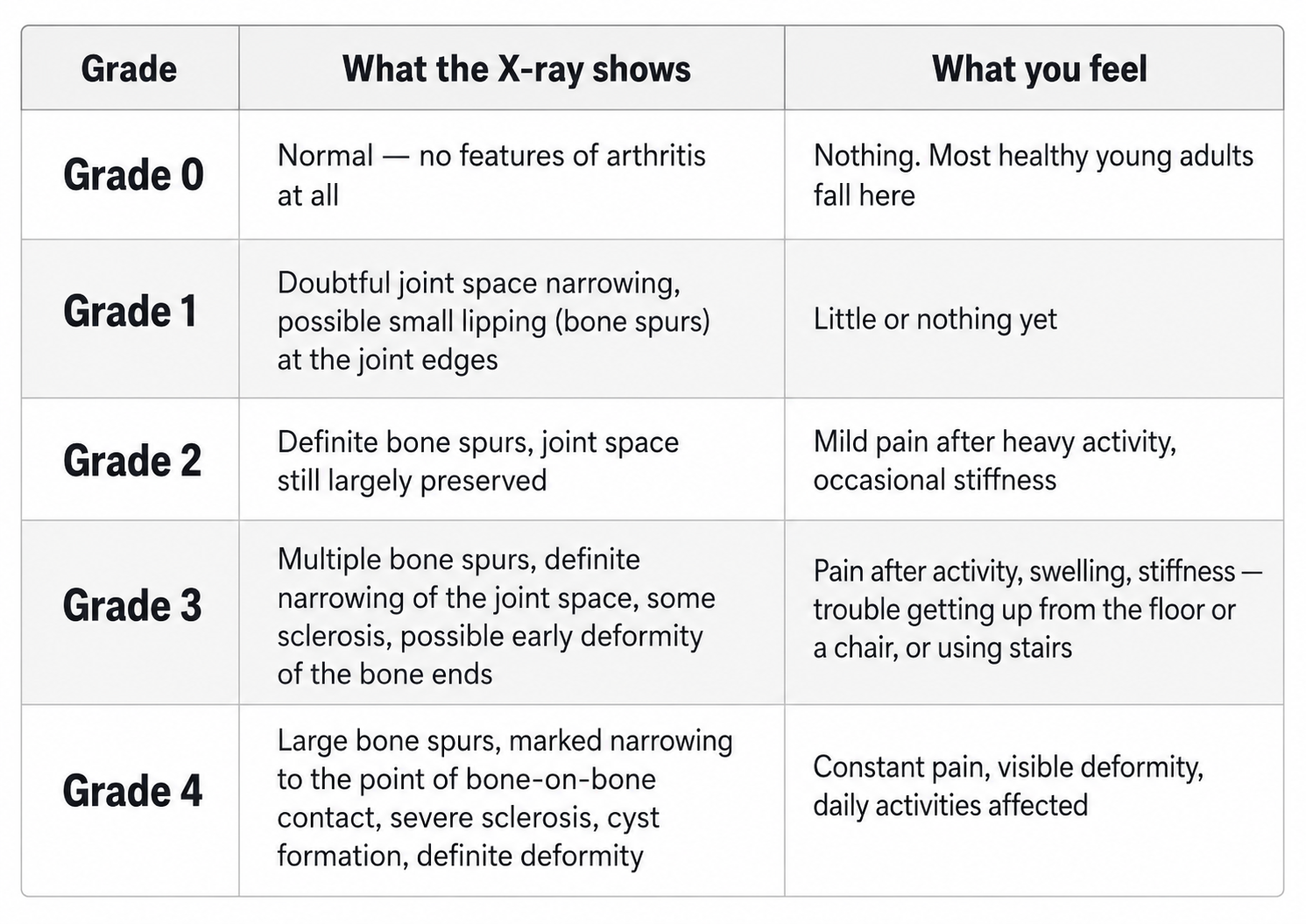
Most patients who finally come to hospital are already in Grade 3. The good news is that Grade 3 still has a wide range of treatment options, and Grade 2 can very often be stopped from progressing at all. Grade 4 is where the options genuinely narrow.
4. What kind of pain suggests arthritis?
Arthritic knee pain is typically gradual in onset — never a sudden, sharp arrival. It builds slowly over weeks and months before becoming severe, and it worsens with sustained activity: standing for long periods, long walks, bending for extended work, or sitting cross-legged for a long time.
5. What are the risk factors, and which ones can I change?
Non-modifiable (you cannot change these): age, female sex — women are affected more than men — and genetic predisposition, if parents or grandparents had arthritis.
Modifiable (these are in your hands):
- Excess weight. Once BMI crosses roughly 23–25 — the cut-off used for Indian populations — the load passing through the knee rises significantly.
- Injuries. Being careful and training properly reduces risk.
- High-impact activity — running, jumping, sport without adequate conditioning.
- Habitual floor sitting, kneeling and squatting. Reducing these delays both onset and progression.
Part 2 — Treatment without surgery
6. Does every patient with knee arthritis need surgery?
No. Most patients who come in with knee pain can be relieved through non-surgical treatment. Dr. Prasad was direct on this point: it is not fair to advise a replacement straight away, because all the conservative options have to be exhausted first.
The non-surgical toolkit includes patient education, lifestyle modification, physiotherapy, weight loss, knee bracing, medication and intra-articular injections.
7. What medicines and injections help?
Oral medication includes the usual pain and anti-inflammatory drugs, plus a specific group — glucosamine and chondroitin sulphate — intended to support cartilage and joint lubrication. All of these are prescription decisions for your treating doctor.
Injections given directly into the knee:
- Corticosteroid injection — a locally acting steroid that reduces inflammation, swelling and pain.
- Hyaluronic acid (viscosupplementation) — a gel-based injection. In arthritic knees, much of the natural joint fluid has been absorbed, leaving bone in closer contact with bone. Replacing that lubrication tends to give quick pain relief and better range of movement. Best suited to Grade 2 and Grade 3, particularly when arthritis is progressing fast.
8. What is a PRP injection, and does it work?
PRP stands for platelet-rich plasma. A sample of your own blood is drawn and processed to concentrate the platelets, which carry growth factors with healing potential. That concentrate is injected straight into the knee. There may be some discomfort initially, but the treatment uses your body's own healing capacity.
It works best in Grade 2 and Grade 3. In Grade 4, with bone already rubbing on bone, PRP will not help. Patients typically need around three injections, one a month, though some respond to a single injection.
Dr. Prasad shared that in his own recent clinical experience, a number of patients who looked likely to need surgery within six months to a year were able to defer it after this treatment. That is a clinical observation from one practice rather than a study finding, and responses vary considerably from patient to patient.
9.What exercise should I be doing instead of walking?
Most older patients do nothing beyond a morning or evening walk. Switching to joint-friendly alternatives is usually better:
- Swimming — the water carries part of your body weight, so the knee is loaded far less.
- Stationary or recumbent cycling — builds strength without loading the joint.
- Elliptical trainer — same principle.
The goal is strengthening the quadriceps, hamstrings and calf muscles, which also serves your cardiovascular health.
10. Which everyday postures should I avoid?
- Try not to bend the knee beyond 90°. Treat 90° as your working ceiling.
- Avoid squatting, sitting cross-legged on the floor, and lunges.
- Sit on a chair, not the floor.
- Avoid low sofas and low chairs. Use something firm and higher, so the knee is not under heavy load getting up or sitting down.
- Avoid repetitive kneeling. Getting up from a kneeling position takes considerable muscular effort, and those forces act on the knee.
- Use bigger joints for heavy work. Push heavy objects with the shoulder or hip rather than the knee; lift using the hip and calf muscles.
11. Can I still walk? How should I pace it?
Yes — but break it up. Instead of walking 30 to 45 minutes continuously, split it into roughly 10 minutes, three or four times a day, with rest intervals in between.
And slow down. There is no harm in walking slower; the faster you go, the higher the joint reaction forces and the faster the damage. If you do resistance work, prefer higher repetitions with lighter weight over heavy lifting.
12. How much does weight loss really matter?
A great deal, at every grade. Extra body weight increases axial loading through the knee, which narrows the joint space, which increases bone-on-bone contact, which accelerates cartilage loss.
An overweight patient sitting at Grade 1 or Grade 2 will move to Grade 3 and Grade 4 much faster. Conversely, an overweight Grade 2 patient who loses weight has a real chance of slowing or halting that progression. If pain makes exercise difficult, shift to swimming or other low-impact activity and work on diet.
Part 3 — Knee braces: which one, and when
13. What are the different types of knee brace?
Three broad categories, and they are not interchangeable.
1. Neoprene knee sleeve (kneecap) — for Grade 1, Grade 2 and very early Grade 3. It provides compression, which reduces swelling and gives the joint some support, so pain drops and walking improves.
2. Hinged knee brace — for patients with instability: those who feel unsure on stairs, who fear falling, or who have lost strength around the knee.
3. Offloader (unloader) brace — the one most patients have never heard of, and the one that can change the outcome most.
14. What does an offloader brace actually do?
The knee has three compartments, but most of the load passes through either the inner or the outer one. When one compartment is worn, that side keeps taking the load and keeps degenerating.
An offloader brace uses a mechanism — typically a thumbwheel dial — to apply pressure from the opposite side, realigning the limb so that the healthier compartment shares the load. On before-and-after X-rays taken with the brace on, you can see the joint space on the affected side open up.
When the joint space opens, lubrication improves and pressure on the damaged cartilage falls. Pain often reduces quickly, and progression slows. The higher the number on the thumbwheel, the greater the corrective force applied.
This is the difference between an offloader and an ordinary sleeve or hinged brace. A compression sleeve gives comfort. An offloader changes where the weight goes.
Every patient can use a sleeve. Some need a hinged brace. Relatively few are given a true offloader — but for the right candidate, it can make a real difference to whether surgery is needed at all. Which type is right for you depends on where your arthritis sits and how your limb is aligned, so this is a decision to make with your surgeon or physiotherapist, not on your own.
Examples of offloader braces available in India include the Breg Freestyle OA, both distributed by Avana Surgical Systems. Other manufacturers make comparable devices
Part 4 — When surgery is genuinely needed
15. How do I know I actually need a knee replacement?
Dr. Prasad listed four signals. Surgery becomes the right answer when:
- Every conservative option has been exhausted — medication, injections, bracing, physiotherapy, exercise and activity modification have all been tried and have not worked.
- You have rest pain or night pain — pain even when you are doing nothing. This is a red flag.
- Indoor daily activities are affected — you cannot walk inside the house, cannot climb stairs, cannot manage ordinary daily living.
- There is a structural deformity — the knee has bent inward or outward.
That last one matters most. Once the knee is visibly deformed, conservative management will not work. Injections, rehab and medicines on a deformed knee will not deliver, and surgery becomes necessary.
16. Is knee replacement the only surgery available?
No. There are four distinct surgical options, and only two of them are replacements.
High tibial osteotomy (HTO) — for patients whose leg bone is angled but whose arthritis is not yet extensive, with reasonable joint space still visible. A controlled cut is made in the bone, the limb is straightened and fixed with a plate and screws. Load then distributes across both sides instead of concentrating on one. Done in time, this can avoid a knee replacement entirely — and you keep your own knee.
Knee arthroscopy — a camera is passed into the joint, fluid is pumped through, and debris, damaged cartilage and inflammatory material are cleaned out, giving good pain relief in selected patients.
Partial (unicompartmental) knee replacement — when only one compartment is arthritic and the other half is still healthy, only the damaged half is replaced. There is less bleeding, less pain, shorter surgical time and a faster return to routine activity. It is essentially a joint preservation surgery: there is no sense replacing a compartment that is still good.
Total knee replacement — for Grade 4, where both sides and the tibial surface are all involved. This is the point at which patients describe a grinding, gravel-like sensation and hear clicking, caused by uneven eroded surfaces rubbing together. Both sides, top and bottom, are replaced; a metal component then articulates against a plastic component for smooth movement.
17. Robotic versus conventional knee replacement — is there a difference?
In the short term, yes. Robotic surgery involves less extensive bone cutting, a smaller incision, less joint disturbance and less damage to surrounding muscle and tendon. That means less pain, less bleeding, better soft-tissue healing and faster recovery.
But at three to six months, there is no difference in outcome. Both groups do well. The advantage of robotic surgery is speed of recovery and earlier return to normal activity — not a better final result.
Part 5 — Patient questions answered live
18. My knee has swelling, stiffness and pain when walking. What should I do?
Tackle each symptom separately.
- For swelling — compression from outside. Wear a knee sleeve or kneecap.
- For swelling with pain — this signals inflammatory build-up inside the joint. Ice the knee.
- For stiffness — mobilisation exercises, bending and straightening the knee, ideally with a physiotherapist's help.
Try this first. But if symptoms persist — and especially if there is a locking sensation and you cannot move the knee freely — get an X-ray soon. Locking may indicate a bone-on-bone block, which needs assessment.
19. Why does my knee hurt more on stairs than on flat ground?
Because of joint reaction forces. On a flat surface, the calf, quadriceps and hamstring muscles do relatively little work. Going upstairs, you are moving against gravity, so those muscles generate far more force — and all of it transmits into the damaged joint.
Coming downstairs might sound easier, but it is not: the muscles have to contract hard to control the descent and stop you falling. Same mechanism. The same applies to getting up from a chair, which is why that also hurts. The arthritis itself has not changed — the muscular load on it has. This is exactly why quadriceps and hamstring strengthening matters so much.
20. Why is my knee pain worse at night?
During the day you are upright and moving, so joint fluid circulates and inflammatory material does not settle. At night the joint becomes static. Lubrication stops circulating, inflammatory material settles inside the joint and starts irritating it, and bone-on-bone contact increases. The pain can be strong enough to wake you, and mornings often begin with a stiff, swollen knee.
What helps: strengthen the muscles around the knee, and ice the knee before bed. If your doctor has prescribed an anti-inflammatory medicine, ask them whether taking it before sleeping is appropriate for you — timing and suitability are a prescribing decision, not a general recommendation.
21. I am 35 with pain on the inner side of my knee. What could it be?
At 35, joint damage and arthritis are unlikely. The first question is whether there was an injury — an accident, a fall, a workout injury, or activity like dancing or badminton — and whether the pain came on suddenly or gradually.
Inner-side (medial) pain after a fall commonly points to a meniscal tear. An MRI is the right next step. A small meniscal injury can often be managed with medication and physiotherapy; if pain persists after a month to six weeks, a PRP injection may be considered.
22. I have a meniscus tear along with arthritis. How is that treated?
The meniscus is a rubber-like pad between the thigh bone and leg bone that works as a shock absorber. When it tears, that shock absorption is lost, bone-on-bone contact follows, and arthritis can develop.
- Meniscal tear with early arthritis → repair the meniscus where it is repairable. Repairing it preserves the joint, and sometimes the joint symptoms settle considerably.
- Meniscal tear with advanced arthritis → the meniscus is often already crushed and cannot be saved. The damaged tissue is removed and a knee replacement is planned.
The message: if a meniscal tear is identified, get it assessed promptly. Left alone, arthritis can follow quickly.
23. Gel injections, PRP and physiotherapy have not given me relief. What now?
A single injection often does not work in patients who present at an advanced stage. Repeating the injection — whether hyaluronic acid, PRP or bone marrow aspirate concentrate — paired with bracing is the usual next step. If the load is concentrated on one side, an offloader brace; otherwise a kneecap. Then give it one to two months.
If there is still no relief after that, a knee replacement may need to be considered.
24. What can be done for Grade 3 arthritis?
Grade 3 is the grey zone — you might need surgery, or you might avoid it entirely. Most Grade 3 patients can be managed conservatively.
Five modalities, used together:
- Medication
- Exercise and strengthening
- Physiotherapy
- Injections
- Bracing
Alongside these, change your lifestyle immediately: stop squatting, stop sitting cross-legged, avoid lunges. Handled properly, Grade 3 can usually be held from progressing to Grade 4. Handled carelessly, progression is rapid.
25. I had a knee replacement two months ago. There is still swelling and my bend is only 90°. Should I worry?
Pain and swelling at two months are expected. Swelling can persist anywhere from six months to a year after surgery — that is normal and not, on its own, a cause for concern.
The 90° range of movement is the part worth attention. Two months post-surgery, that is a little low. It is addressed with focused physiotherapy — knee stretches to improve range, plus icing and compression. There is time to correct it.
For reference: within a month of surgery, thinner patients often reach 90° to 120°. 90° is the minimum every patient should achieve after a knee replacement. Raise this with your operating surgeon at your next review so your rehab can be adjusted.
26. I already have Grade 4 arthritis. Is there any hope without surgery?
Yes — a trial is worth it. A Grade 4 X-ray does not mean you must go straight under the knife.
Options are genuinely limited, though. Gel and PRP injections will not help, because there is already bone-on-bone contact — that money would be wasted. What can be tried:
- A corticosteroid injection into the joint, which can give real pain relief
- Bracing
- Physiotherapy and rehabilitation
- Strengthening exercises
This will slow progression a little. It will not reverse it, and it is important to be practical about that. But as Dr. Prasad put it, nature deserves one last chance to heal. If conservative management is given a fair trial and fails, then a replacement can be planned.
Watch the full webinar
Do You Really Need a Knee Replacement? | Dr.Joel Prasad Explains
The takeaway
Two messages ran through the whole session.
First: get it looked at early. Arthritis found at Grade 2 or early Grade 3 has a long list of treatment options. Arthritis found at Grade 4 has very few. The gap between those two situations is often just a few years of ignoring the pain.
Second: knee replacement is the last step, not the first. Between "you have arthritis" and "you need a replacement" sit medication, injections, physiotherapy, exercise, weight management, three different types of brace, high tibial osteotomy, arthroscopy and partial replacement. Most patients never need to reach the end of that list.
If someone has recommended a knee replacement and you are unsure, the questions to ask yourself are the four Dr. Prasad listed: have all conservative options genuinely been tried, do you have rest or night pain, are your indoor daily activities affected, and is the knee deformed?
What to do next
Get the free knee exercise booklet. The AAOS-recommended knee exercise programme discussed during the webinar — illustrated, printable, and designed to be worked through with your doctor or physiotherapist. Enter your WhatsApp number to receive it →
Try an offloader knee brace. If your arthritis is concentrated on one side of the knee, an offloader may be worth assessing.
- Freestyle OA: free trial fitting available. Book a fitting on WhatsApp →
- Browse braces online: Osteokart →
Bring your most recent X-ray or report to any fitting appointment — it makes the assessment far more useful.
Related reading: Knee Pain Without Injury: Common Causes You Should Know
