
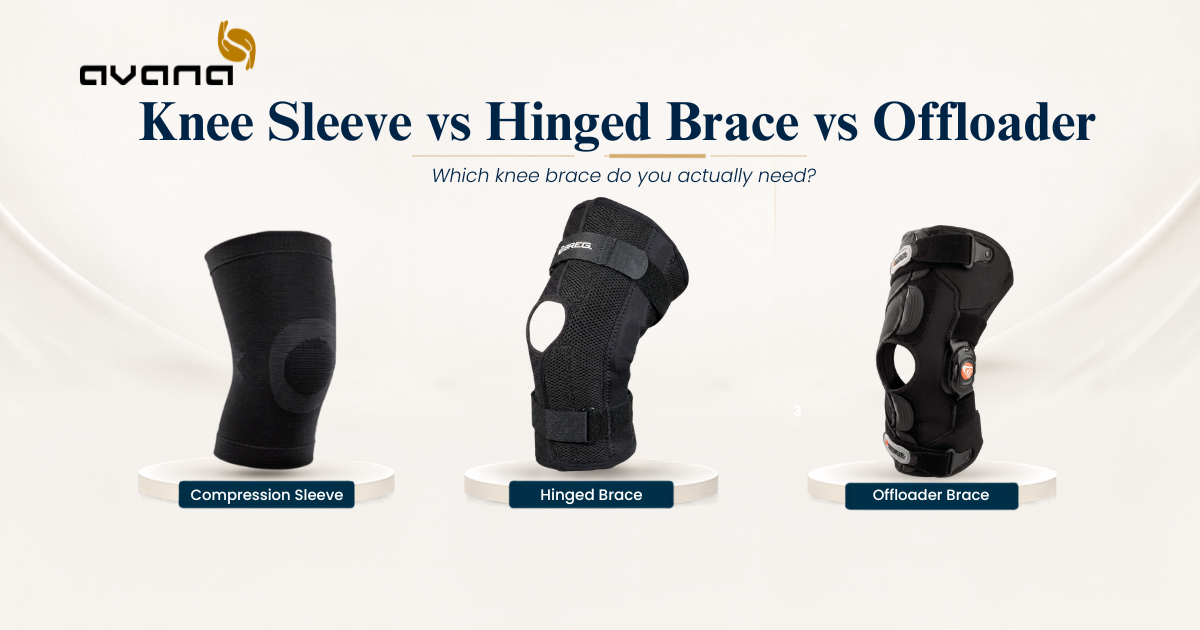
Knee Sleeve vs Hinged Brace vs Offloader: Which Knee Brace Do You Actually Need?
Medical disclaimer: This article is general health education, not a diagnosis or a prescription. Brace selection depends on your alignment, your grade of arthritis and your symptoms. Please have any brace recommended and fitted by your orthopaedic surgeon or physiotherapist.
Disclosure: Avana Surgical Systems distributes Breg and Aspen Medical Products braces in India, including the offloader braces described here. We have tried to describe the category honestly, including where a brace is not the right answer.
Walk into any pharmacy in India and ask for a knee brace, and you will be handed a stretchy black sleeve. It costs a few hundred rupees, it feels supportive, and for a lot of people it helps a little.
For a lot of other people, it does almost nothing — and they conclude that braces don't work.
The problem is not that braces don't work. The problem is that "knee brace" describes at least three completely different devices that solve three completely different problems. Giving a compression sleeve to someone with one-sided arthritis is like giving reading glasses to someone who is short-sighted. It is the right category and the wrong device.
This guide explains what each type actually does, so you can have a more useful conversation with your doctor.
First, what does the research say about bracing at all?
Worth knowing before we go further, because a lot of people assume braces are a comfort item rather than a treatment.
Two major clinical guidelines address this directly.
The American College of Rheumatology and Arthritis Foundation guideline (2019) strongly recommends tibiofemoral knee braces for patients with knee osteoarthritis where the disease is having a large enough impact on walking, joint stability or pain to justify an assistive device. "Strongly recommended" is the highest tier in that guideline — the same tier as exercise and weight loss.
The American Academy of Orthopaedic Surgeons guideline (2021) gives brace treatment a moderate recommendation for improving function, pain and quality of life in knee osteoarthritis.
Two things to take from this. Bracing is a recognised part of conservative management, not a shop-counter accessory. And the guidelines are specific about which brace and which patient — which is exactly the distinction most people never get explained.
Type 1: The compression sleeve (what most people call a "knee cap")
What it is: A neoprene or elastic sleeve that you pull on. No hinges, no straps, no adjustment. This is the one sold everywhere.
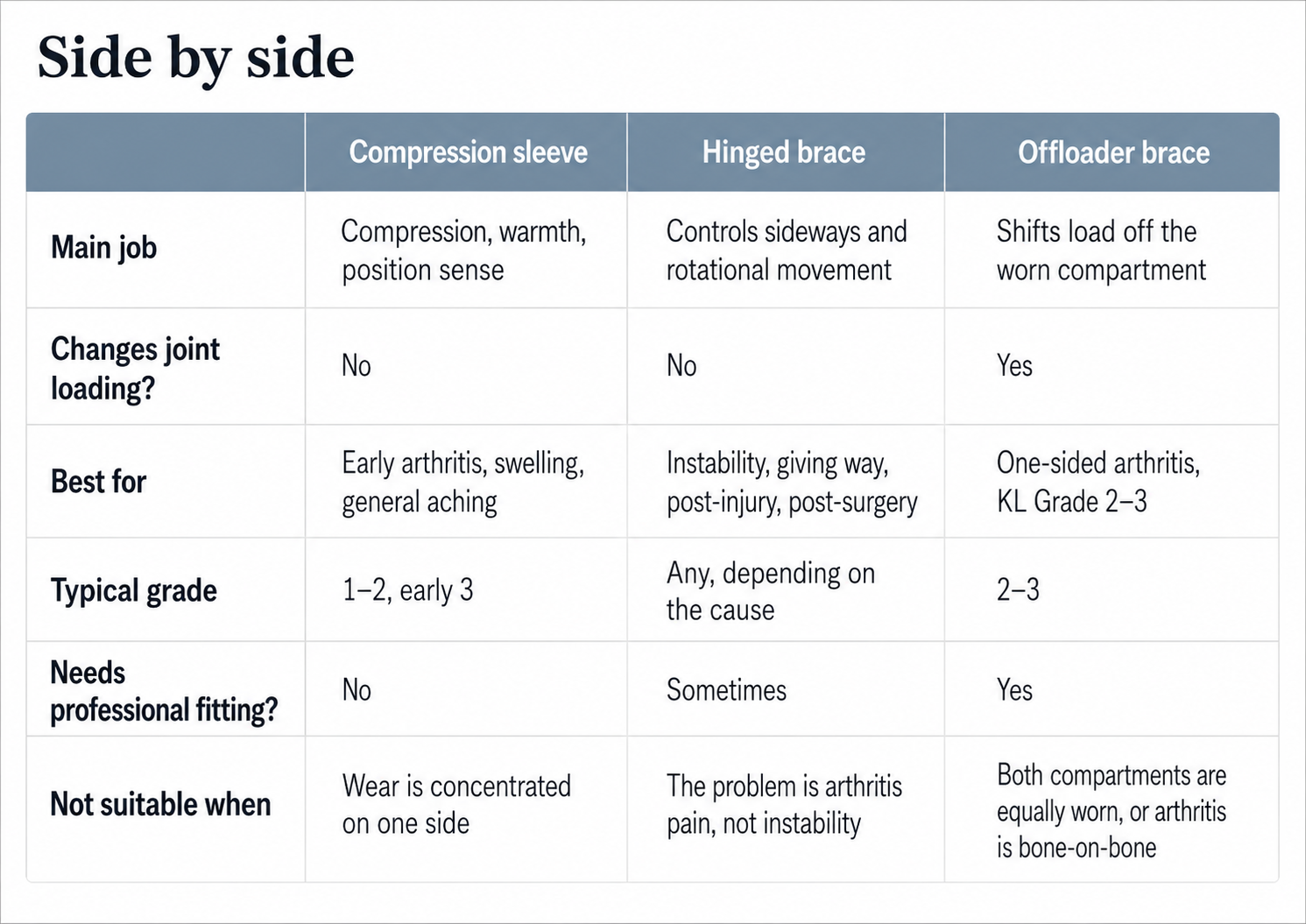
What it actually does: It applies even compression around the joint. That does three useful things — it reduces swelling, it provides warmth, and it improves proprioception, which is your body's sense of where the joint is in space. Better proprioception means you feel steadier, and feeling steadier means you walk more normally.
What it does not do: It does not change how weight passes through your knee. It does not stabilise a knee that gives way. It cannot correct alignment.
Who it suits: Early arthritis — Grade 1, Grade 2, and early Grade 3. Also useful for general activity-related swelling and aching, and as a temporary measure while you wait for a proper assessment.
The honest limitation: If your pain is concentrated on one side of the knee and your X-ray shows the joint space narrowed on that side, a sleeve will make the knee feel better without changing what is causing the damage. That is a comfort benefit, not a mechanical one — worth having, but don't mistake it for treatment.
Type 2: The hinged brace
What it is: A brace with rigid or semi-rigid uprights on either side of the knee, connected by mechanical hinges that allow bending and straightening while resisting sideways movement.
What it actually does: It controls unwanted motion. The hinges let the knee flex and extend normally but resist the joint buckling sideways or twisting.
Who it suits: People whose primary problem is instability rather than arthritis pain. The typical description is someone who feels unsure on stairs, who is afraid the knee will give way, or who has lost strength around the joint. It is also standard after ligament injuries and after certain knee surgeries, often with the range of motion deliberately limited during healing.
The honest limitation: A hinged brace does not offload an arthritic compartment. If your problem is one-sided wear rather than the knee giving way, this is the wrong tool. It will feel more substantial than a sleeve, and that solidity is often mistaken for effectiveness, but it is not treating the mechanical cause.
Type 3: The offloader (unloader) brace
This is the one most patients have never heard of, and the one that does something genuinely different.
The problem it solves. Your knee has three compartments. In most people with osteoarthritis, the wear is not spread evenly — it concentrates in one compartment, usually the medial (inner) side. Once that happens, a cycle sets in. The worn side is lower, so the leg angles slightly. The angle sends more load onto the already-worn side. More load means more wear and more pain. More pain means you move less, the supporting muscles weaken, and the joint is protected even less.
Malalignment drives loading, loading drives pain, pain drives deconditioning. Left alone, that cycle only runs one direction.
What the brace does. An offloader uses a three-point pressure system, usually adjusted with a thumbwheel dial, to apply a gentle corrective force from the opposite side of the knee. This shifts a portion of the load off the damaged compartment and onto the healthier one.
On X-rays taken with the brace fitted and the patient standing, you can often see the joint space on the affected side visibly open compared with the same knee unbraced.
Who it suits: Patients with unicompartmental (one-sided) knee osteoarthritis, typically KL Grade 2 to Grade 3, where one compartment is worn and the other is comparatively healthy. That last condition matters — the whole mechanism depends on there being a healthier compartment to shift load onto.
The honest limitations: An offloader is not for everyone. If both compartments are equally arthritic, there is nowhere to shift the load. If arthritis is advanced to bone-on-bone across the joint, the benefit shrinks considerably. It is bulkier than a sleeve and takes some getting used to. And a brace that isn't worn provides no benefit at all — the ACR guideline explicitly notes that patients need to be able to tolerate the inconvenience of bracing for it to work.
It also requires proper fitting. An offloader set to the wrong correction, or sized wrong, will be uncomfortable and ineffective. This is not a device to order online and figure out yourself.
How to work out which one applies to you
Four questions, in order.
1. Does your knee give way, or feel like it might? If yes, instability is the primary issue and a hinged brace is the likely direction. This overrides the others — a knee that buckles is a falls risk before it is an arthritis problem.
2. Is your pain on one side of the knee specifically? Point to where it hurts. If your finger lands consistently on the inner side or the outer side, and your X-ray shows narrowing on that side, an offloader is worth assessing.
3. Is the pain general and diffuse, with swelling? Aching all around the joint, worse after activity, some puffiness — a compression sleeve is a reasonable starting point.
4. Is your leg visibly bowed inward or outward? Structural deformity changes the picture entirely, and conservative management including bracing becomes much less likely to help. This needs a surgical opinion. We covered this in more detail in our full Q&A on knee replacement.
Take your most recent X-ray to the appointment. Brace selection depends on which compartment is affected and how the limb is aligned — neither of which is visible from the outside.
Three things people get wrong
"The tighter the better." No. A brace that cuts off circulation, leaves deep marks or causes numbness is fitted wrong. You should be able to wear it for hours without thinking about it.
"I'll wear it all day, every day." Braces are for loaded activity — walking, standing, stairs, work. Wearing one while sitting or sleeping does nothing useful, and relying on external support without doing your strengthening work lets the quadriceps and hamstrings weaken further. The brace is meant to let you move more so you can strengthen, not to replace strengthening.
"A brace will fix my arthritis." It will not. Cartilage that has been lost does not grow back. What a well-chosen brace does is reduce pain, improve function, and take load off a damaged compartment — which can slow how quickly things progress and, for some patients, meaningfully delay the point at which surgery becomes necessary. That is worth a great deal. It is not a cure, and anyone who tells you otherwise is selling something.
Three things people get wrong
"The tighter the better." No. A brace that cuts off circulation, leaves deep marks or causes numbness is fitted wrong. You should be able to wear it for hours without thinking about it.
"I'll wear it all day, every day." Braces are for loaded activity — walking, standing, stairs, work. Wearing one while sitting or sleeping does nothing useful, and relying on external support without doing your strengthening work lets the quadriceps and hamstrings weaken further. The brace is meant to let you move more so you can strengthen, not to replace strengthening.
"A brace will fix my arthritis." It will not. Cartilage that has been lost does not grow back. What a well-chosen brace does is reduce pain, improve function, and take load off a damaged compartment — which can slow how quickly things progress and, for some patients, meaningfully delay the point at which surgery becomes necessary. That is worth a great deal. It is not a cure, and anyone who tells you otherwise is selling something.
Where a brace fits in the overall plan
Bracing is one part of conservative management, not the whole of it. The guidelines that recommend bracing recommend it alongside exercise, weight management, physiotherapy and appropriate medication. A brace paired with a strengthening programme does considerably more than a brace on its own.
If you have knee arthritis and have not yet been through a structured trial of all of these, you are not out of options — that is the central message of our full Q&A with Dr. Joel Prasad on when a knee replacement is genuinely needed.
What to do next
Not sure which brace applies to you? Bring your X-ray to your orthopaedic surgeon or physiotherapist and ask specifically: which compartment is affected, and is my alignment normal? Those two answers determine the brace.
Considering an offloader? We offer a free trial fitting for the Breg Freestyle OA in select cities, so you can feel the difference in load before deciding. [Book a fitting on WhatsApp →]
Browse the full range: Osteokart →
Related reading:
